
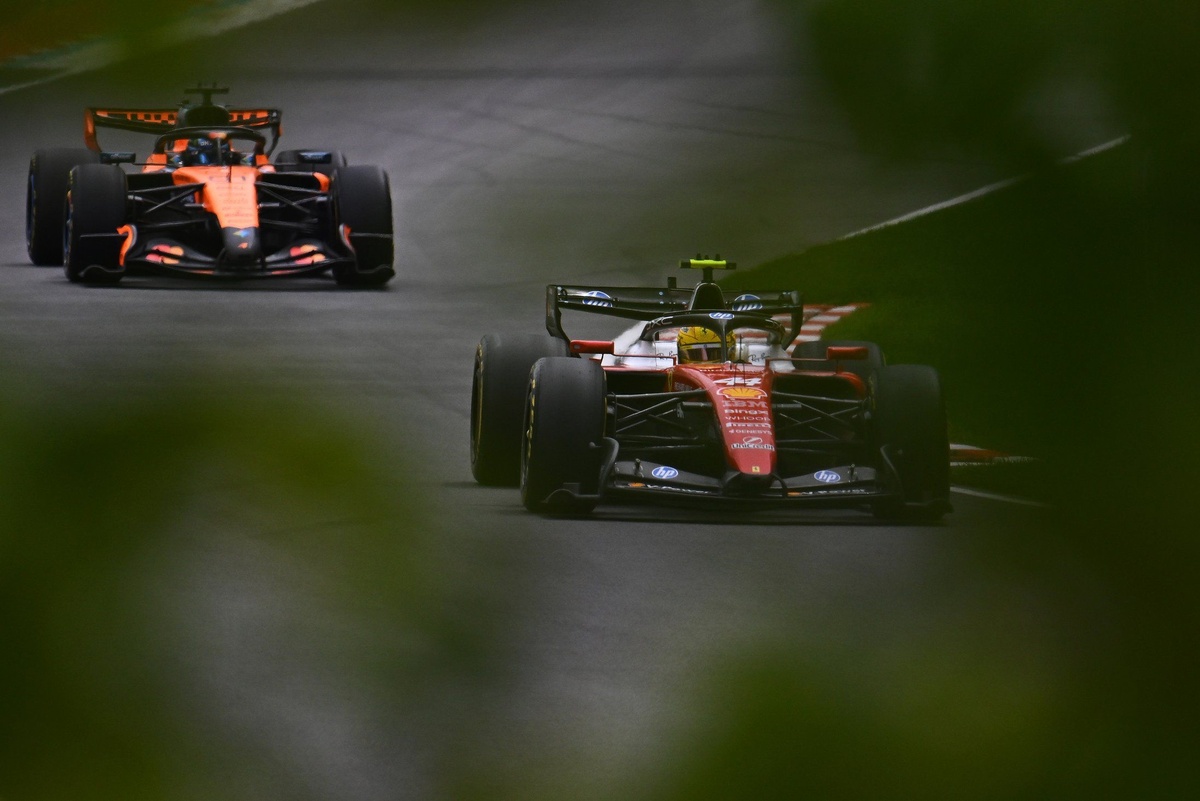
Stewards Clear Lewis Hamilton of Wrongdoing in Canadian GP Sprint
The stewards at the 2026 Canadian Grand Prix have concluded their investigation into Lewis Hamilton’s alleged infringement during the sprint race, and the Ferrari driver has been cleared of any wrongdoing.
The incident in question occurred in the final chicane of the Gilles Villeneuve Circuit, where Hamilton was accused of leaving the track and gaining an advantage. The stewards examined the matter closely, considering whether Hamilton had gained an unfair advantage or maintained his position illicitly.
The Incident Under Investigation
Hamilton was under investigation for allegedly leaving the track and cutting across the chicane at the end of the Circuit Gilles-Villeneuve. The incident happened while he was battling Oscar Piastri for position. Although Hamilton initially held fourth place, he eventually lost it to Piastri and then dropped further to sixth behind Charles Leclerc.
The stewards’ inquiry focused on whether Hamilton’s actions constituted a breach of the regulations. They analyzed the situation, comparing it to a similar incident involving Nico Hülkenberg, who was penalized for cutting across the same chicane during a battle with Liam Lawson.
Stewards’ Rationale for Clearing Hamilton
The stewards ultimately decided not to penalize Hamilton, citing a crucial difference between his situation and Hülkenberg’s. In Hamilton’s case, Piastri was not attempting to overtake him at the time he left the track. The stewards’ full explanation for their decision reads: “The car No. 44 [Hamilton] was ahead of car No. 81 [Piastri] approaching Turn 13; it left the track, crossed the chicane, and rejoined the track ahead of car No. 81.“
They continued: “However, this incident differs from the previous incident in this session involving cars 27 [Hülkenberg] and 30 [Lawson] in that car 81 was not in a position to overtake car 44.“
The stewards concluded: “As a result, the stewards determined that car 44 was not ‘defending’ its position and therefore did not gain a lasting advantage, in accordance with the Driving Standards Guidelines.“
Comparison with Hülkenberg’s Penalty
In contrast, Hülkenberg was penalized for a similar infraction. The stewards’ justification for Hülkenberg’s penalty was that he had left the track while defending his position against Lawson, thereby gaining a lasting advantage.
The stewards stated: “The car No. 27 left the track at Turn 13 while defending its position against car No. 30 at the entry to the said turn; in doing so, it gained a lasting advantage over car No. 30 by maintaining its position.“
They added: “The driver rejoined the track ahead of car No. 30 and did not give up the position.“
The stewards’ decision on Hülkenberg was clear: “The stewards determined that car No. 27 was ‘defending’ its position.“
They concluded: “The stewards determined that car No. 27 gained a sporting advantage in terms of position and did not give up that advantage. In accordance with the Driving Standards Guidelines, this is considered an infringement, and the basic penalty of 10 seconds is applied.“
Implications of the Stewards’ Decision
The stewards’ decision to clear Hamilton of wrongdoing highlights the nuances involved in interpreting the regulations. It demonstrates that the context of each incident is crucial in determining whether a driver has gained an unfair advantage.
This distinction is important for drivers, teams, and fans to understand, as it underscores the complexity of applying the rules in high-pressure racing situations.
Conclusion
The stewards’ decision in the Lewis Hamilton case serves as a reminder that the application of racing regulations requires careful consideration of the specific circumstances surrounding each incident. As the Formula 1 season continues, such nuanced decisions will remain critical in shaping the outcome of races and the championship.
For the latest updates on the Formula 1 season and in-depth analysis of racing incidents, stay tuned to our coverage.
 "
"