
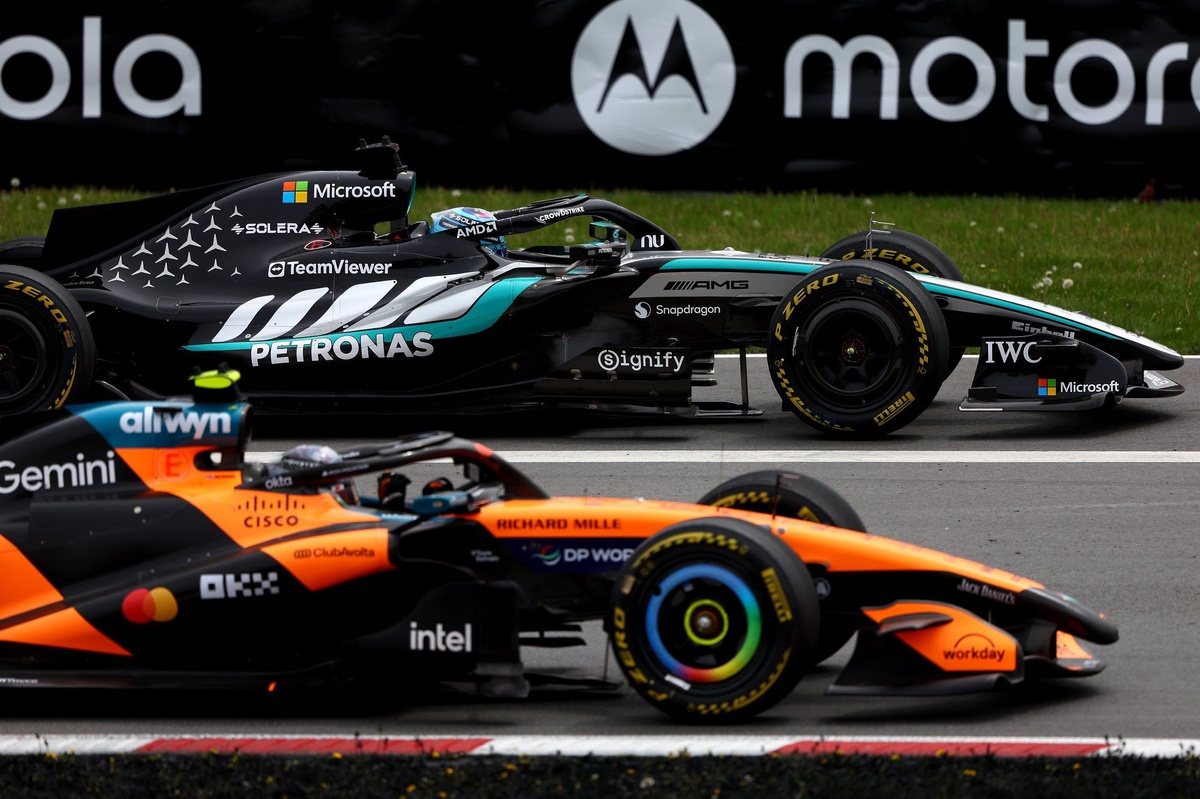
McLaren’s short‑ratio gearbox has repeatedly generated faster launches than Mercedes, even though both teams run the identical Mercedes power unit under the new 2026 Formula 1 regulations.
Short‑ratio strategy gives McLaren a launch edge
Designing and building its own gearbox, McLaren selected shorter gear ratios for the MCL40, a choice that amplifies torque at the driven wheels and improves low‑speed acceleration. Team principal Andrea Stella highlighted the benefit during the Canadian Grand Prix weekend, noting that the setup can “give you some advantages in acceleration, possibly in a start.” This approach has translated into noticeably stronger starts across the first five Grands Prix.
Long‑gear advantage fuels Mercedes on high‑speed sections
Mercedes, along with Red Bull, favours relatively long lower gears, a configuration that keeps engine revs higher through slow corners and maximises MGU‑K‑driven battery recharge. On circuits featuring long straights, the W17 retains higher top‑speed capability, often pulling ahead of McLaren once the straight extends beyond the early acceleration phase.
Energy‑recovery limits expose gearbox trade‑offs
Miami’s qualifying allowed the full 8 MJ of energy recovery, while Canada capped it at 6 MJ per lap. In Miami, McLaren stayed alongside the front‑runners on the opening straight but fell off the pace as the straight lengthened, a deficit traced to the combination of a short eighth gear and earlier electrical energy expenditure. In Canada, the MCL40 matched Mercedes on short sector‑2 straights (≈ 290 km/h) but lost ground on the long straight into the final chicane, where Mercedes’ longer gear delivered higher velocity.
Teams may tweak ratios once this season, but McLaren stays the course
The 2026 rulebook permits a single mid‑season gearbox‑ratio change after homologation. Stella dismissed the need for a revision, arguing that the current short‑ratio setup delivers net gains across most track types, even if it cedes some advantage on the longest straights. Consequently, McLaren continues to leverage its existing configuration while monitoring circuit‑specific performance.
The emerging picture suggests that gearbox‑ratio philosophy, rather than raw power unit output, now shapes lap‑time differentials, with each philosophy excelling on distinct circuit characteristics.
 "
"