
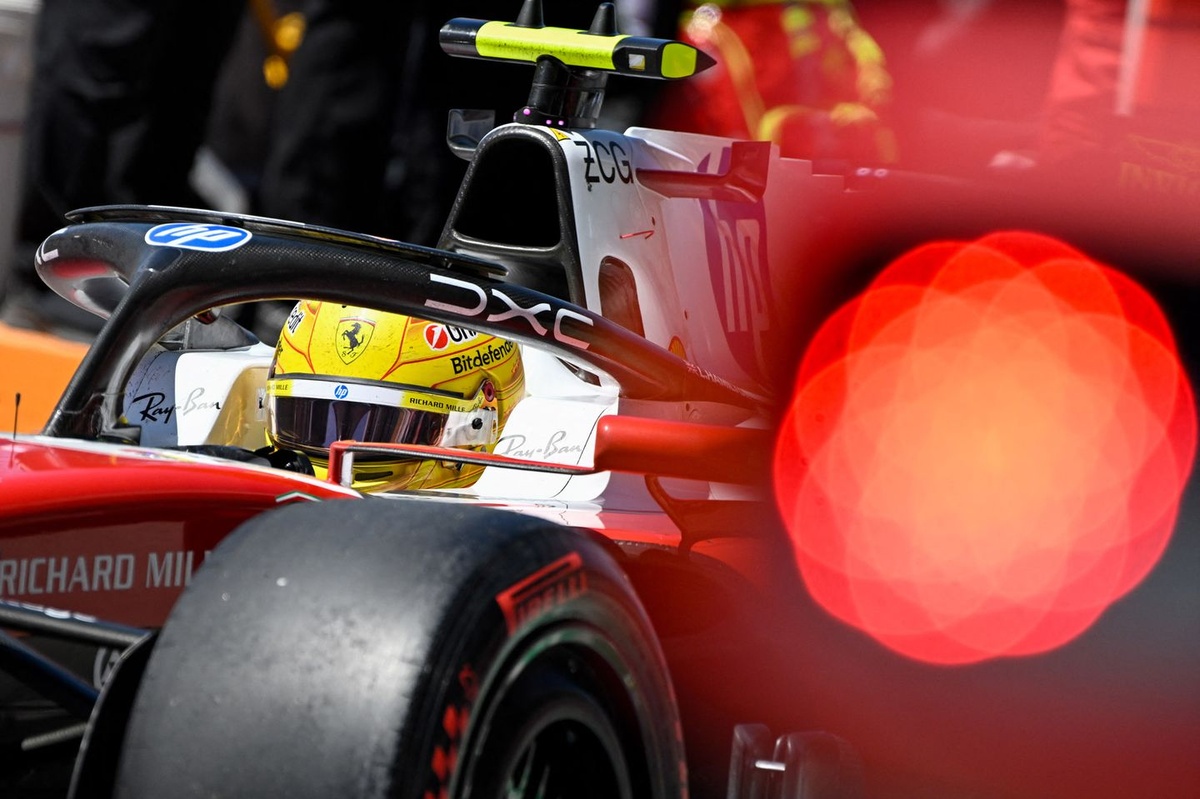
Lewis Hamilton Skips Simulator for Canadian GP, Sees Improvement
In an era where technology is constantly evolving and every detail can make a difference, Lewis Hamilton’s decision to skip the simulator for the Canadian Grand Prix might seem surprising. However, the seven-time world champion has apparently reverted to old habits that have proven effective. Despite not using the simulator, Hamilton has shown significant improvement at the wheel of his Ferrari.
Although his sprint race ended bitterly, with two places lost in the final corner to Oscar Piastri and Charles Leclerc, Hamilton appeared much more comfortable driving than in his recent outings. On the Gilles-Villeneuve circuit, he outperformed his teammate in both qualifying sessions. While Ferrari isn’t at the top of its game, Hamilton’s sensations are on track.
Hamilton’s Confidence Boost
“It was great,” Hamilton said after qualifying on Saturday evening. “We made some good changes in qualifying. I was hoping for a better result, but I didn’t manage my last lap. The car felt like we were making progress. Honestly, if I had done that last lap, I think I probably could have been third.”
Hamilton attributes his renewed confidence behind the wheel to several factors: “It’s the brakes, the stability at the entry of corners, and with the settings I was heading towards, I’m much, much more satisfied with my ability to attack corners.”
Hamilton’s History with Simulators
On Thursday, during the FIA press conference on the eve of the first practice session, Hamilton explained his decision to skip the simulator, reverting to habits more akin to those he had at Mercedes in previous years.
“First of all, the simulator is incredible,” he emphasized. “It’s an incredible workspace. It’s the best simulator I’ve ever seen, and the best team of people I’ve worked with in this area, a great team with which I can collaborate. So, a day at the simulator is actually quite incredible.”
Hamilton has a long history with simulators, dating back to 1997 when he first used one at McLaren. He noted that while simulators are powerful tools, he never particularly enjoyed using them, especially during his time at McLaren when they were used relatively frequently.
Evolution of Simulator Use
When Hamilton joined Mercedes, they were behind on simulator technology. He didn’t use it much during the title-winning seasons and only started using it more frequently in 2020 and 2021.
“There was only one time, out of all those years, when the settings I had on the simulator were exactly the ones I used in qualifying to sign pole, and that was in Singapore in 2012, maybe something like that. All the other times, it wasn’t perfectly aligned,” Hamilton recalled.
Rethinking Simulator Reliance
Last year, Hamilton began using the simulator every week, but often felt like he was doing all the work on the simulator, finding settings he was comfortable with, only to arrive on the track and find everything was opposite. “So you have to unlearn what you’ve worked on, change your approach to corners, and a setup that seemed good on the simulator isn’t necessarily good on track. Sometimes yes, but it’s a bit random.”
For the Canadian GP, Hamilton decided not to use the simulator and instead focused more on data analysis. There was in-depth work on corner balance, mechanical balance, cornering approaches, braking balance, and brake optimization, which has been a problematic area for him.
“It’s not a tool that… I’m not saying I’ll never use it again. It’s something we’ll continue to use, especially for power unit management. We’ll see how the weekend unfolds. But in China, for example, I didn’t do the simulator, and it was my best weekend.”
Conclusion
Hamilton’s decision to skip the simulator for the Canadian GP has paid off, with the driver showing significant improvement. While simulators are powerful tools, Hamilton’s experience highlights the importance of not relying too heavily on them. As the season progresses, it will be interesting to see how Hamilton continues to balance his use of simulator technology with real-world track time.
For fans and followers of Formula 1, Hamilton’s approach serves as a reminder of the complexities involved in fine-tuning a car for optimal performance. As the sport continues to evolve, drivers and teams must adapt their strategies to stay ahead of the competition.
 "
"