
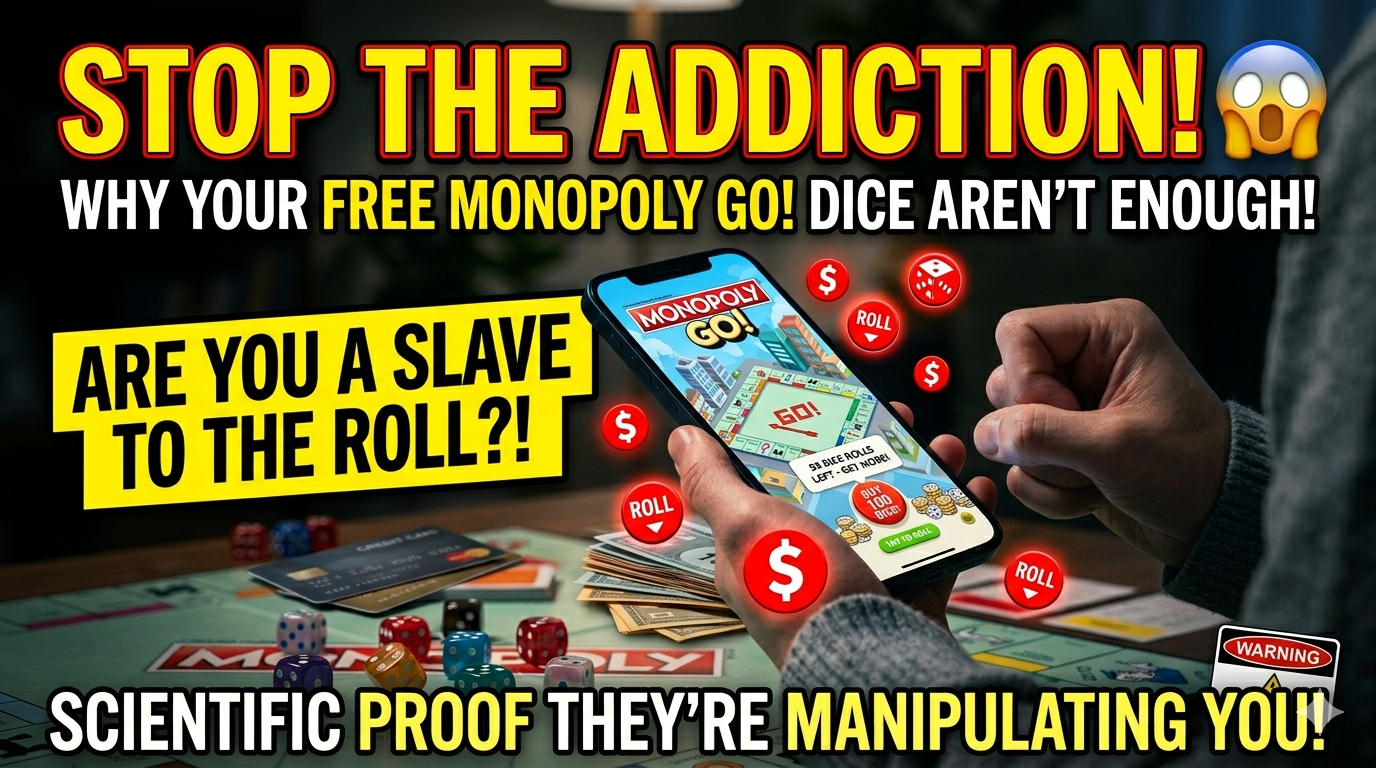
You open the app. A cheerful animation plays. A gift box bounces on screen: “Your daily reward is ready!” You tap it. Dice pour out. A little dopamine hit. You start rolling. This is not an accident.
The mechanics behind games like Monopoly Go, Coin Master, and dozens of other mobile titles are the product of years of behavioral psychology research, A/B testing, and deliberate design. Understanding how these systems work doesnt ruin the fun it gives you the power to engage with them on your own terms.
The Core Loop: Roll, Reward, Repeat
Every successful free-to-play game is built around a core loop a short cycle of actions and rewards that players repeat constantly. In Monopoly Go, that loop is:
Roll dice → Land on tile → Receive reward → Want to roll again
The loop is deliberately short (seconds, not minutes) and always ends with an incomplete feeling theres always one more thing you could do if you just had a few more dice. This is the fundamental engine of engagement.
Psychologists call this a variable ratio reinforcement schedule the same mechanism that makes slot machines so compelling. You dont know what reward youll get on the next roll, and that uncertainty is more motivating than a guaranteed reward would be. The brain keeps chasing the next surprise.
Scarcity: The Power of Running Out
Dice arent infinite. Thats not a limitation its a feature. When you run out of dice, you face a choice: wait for your free refill, spend currency to get more, or stop playing. This moment of friction is designed to do several things at once:
- Create desire you want to keep playing but cant
- Establish value scarcity makes dice feel precious
- Present a solution the game offers to sell you more
Free-to-play designers call this a energy system or stamina system. It controls the pace of play, prevents players from completing everything in one sitting, and creates a recurring need that brings players back daily.
The refill timer “your dice will be ready in 47 minutes” is a retention mechanism. It gives you a reason to return at a specific time, building a habit loop.
Daily Rewards: Building the Habit
The daily login reward is one of the oldest tricks in the free-to-play playbook, and it works remarkably well. The structure is usually:
- Day 1: Small reward (a few dice)
- Day 3: Medium reward
- Day 7: Big reward
- Miss a day: Reset (or lose your streak bonus)
This is a commitment escalation technique. The longer your streak, the more you have to lose by missing a day. Players whove logged in for 20 consecutive days feel a pull to maintain that streak that has nothing to do with how much theyre enjoying the game.
The reward itself matters less than the ritual. Opening the daily gift box, tapping through the animation, seeing numbers tick up these micro-interactions trigger small hits of anticipation and satisfaction that reinforce the habit of opening the app.
Social Pressure and FOMO
Monopoly Go layers social mechanics on top of its core loop in ways that amplify engagement significantly.
Friends gifting dice creates mutual obligation if your friends are sending you dice, you feel compelled to send back. This isnt just generosity; its a social contract that keeps both parties logging in.
Leaderboards and tournaments introduce competitive pressure. Seeing your name near the top of a rankings board activates status-seeking instincts. Falling behind creates anxiety. Both responses drive more play.
Limited-time events are perhaps the most powerful social lever. The message is always the same: this opportunity ends soon, and if you dont act now, youll miss it forever. This is classic FOMO (fear of missing out), and its extraordinarily effective at converting passive players into active ones and active players into paying ones.
Event timers, progress bars, and milestone rewards all work together to make players feel that stopping would mean wasting the progress theyve already made. Behavioral economists call this the sunk cost effect.
The Monetization Funnel
Free-to-play games dont expect every player to spend money. The business model is built around a small percentage of players sometimes called whales who spend large amounts.
The funnel typically looks like this:
Free players (majority) → enjoy the game, provide social content, fill leaderboards Minnows → spend small amounts occasionally, usually on a “great deal” Dolphins → spend regularly, $10–$50/month Whales → spend heavily, sometimes hundreds or thousands per month
The game is designed to move players down this funnel gradually. The first purchase is often deliberately cheap a “starter pack” at $1.99 or $2.99. Once someone has spent any money, the psychological barrier to spending more drops significantly. This is the foot-in-the-door technique applied to commerce.
After the first purchase, the game begins offering larger, time-limited bundles with urgency messaging: “67% off offer expires in 2:14:33.”
The “Free” in Free-to-Play
None of this means these games are evil or that enjoying them is a mistake. Millions of people play Monopoly Go for free and have a great time. The mechanics described above are real, but so is genuine enjoyment.
Whats important is informed consent. When you understand that:
- Running out of dice is a designed friction point, not a flaw
- Daily rewards are habit-formation tools, not gifts
- Limited-time events are engineered urgency, not genuine scarcity
- “Free” dice from third-party sites are not legitimate and often dangerous
you can engage with the game on your own terms. You can enjoy the core loop without being driven by anxiety. You can appreciate the social features without feeling manipulated by them.
The dice will run out. The event timer will hit zero. Another one will start tomorrow. Knowing that takes the pressure off and, ironically, often makes the game more fun.
Questions Worth Asking
If you play any free-to-play mobile game, these questions are worth asking yourself occasionally:
- Am I playing because Im enjoying it, or because Im anxious about losing a streak?
- Did I spend money because I wanted to, or because a timer was counting down?
- How much time am I spending daily, and is that the amount Id consciously choose?
- Am I having fun, or am I just completing objectives?
The games are designed to blur the line between those things. Keeping it clear is the players job.
 "
"