
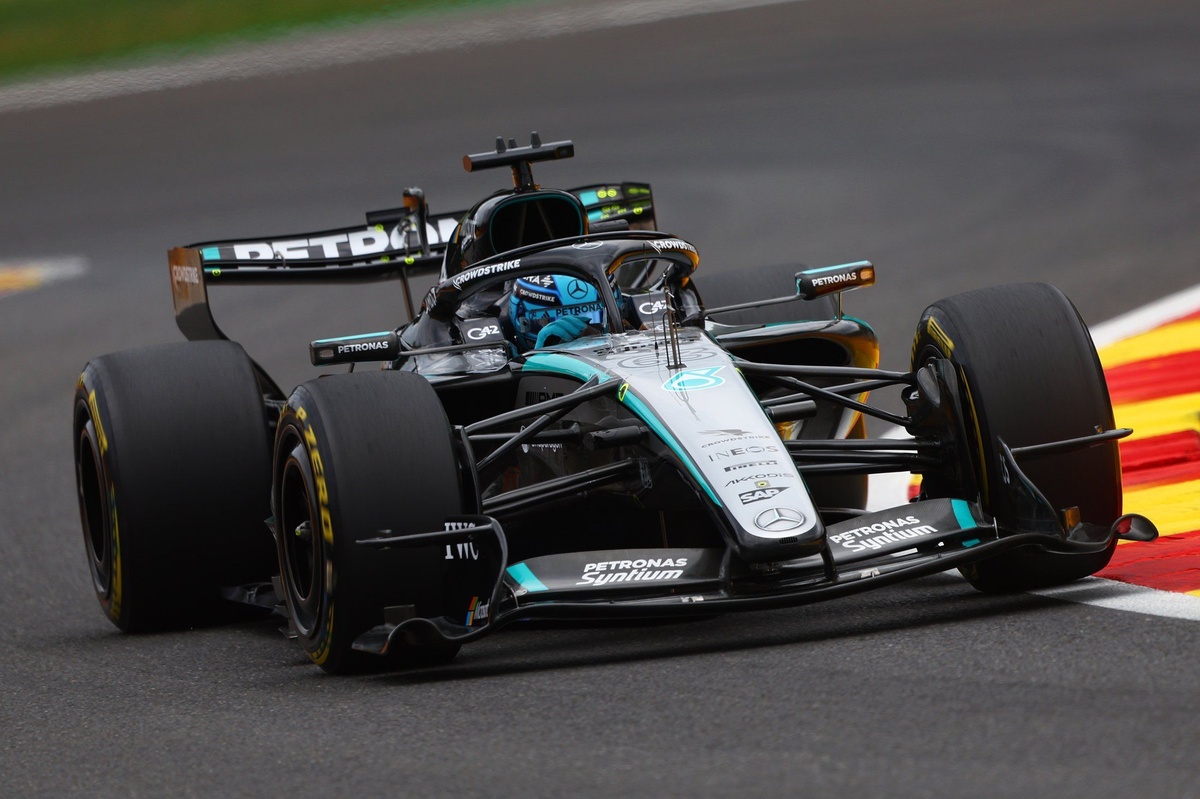
Mercedes sprint driver George Russell confirmed that his performance deficit at Spa is not due to his driving style but remains unexplained, citing a 0.508‑second gap to teammate Kimi Antonelli on the pole lap.
Chasing Straight‑Line Speed
During Friday qualifying, Russell identified a reduction in straight‑line acceleration. In FP1 and FP2 he struggled to match Antonelli, losing eight tenths; the margin shrank to four tenths in Q3, yet the deficit still lingered.
He described it as “infuriating”: “Every lap I see a loss of two to six tenths on the straights. It feels powerless when I’m on full throttle.”
Tracking the Gap on Track
Data analysis flags the final straight between Blanchimont and the chicane as Russell’s primary weakness. The loss grows linearly from one tenth at Stavelot to five tenths approaching the chicane.
Marcus Dudley, the race engineer, pointed out that Turn 14 “Campus” also registers a small time loss in Q3, yet the cumulative impact manifests at the final straight.
Power Unit or Energy Management?
The 2026 regulations introduce a smaller battery capacity. Drivers who cut corners too sharply and then demand electrical assistance may find their charge depleting sooner at “energy‑starved” circuits like Silverstone and Spa.
Speakers denied a power‑unit fault. “It isn’t the power unit,” Wolff said, while hypothesizing that Antonelli might have a fresher engine, hence the speed advantage.
Team Statements and Ongoing Investigation
Wolff admitted that Mercedes has “left no stone unturned” and remains uncertain about the cause. The team is evaluating whether the issue will persist on tracks with fewer energy‑starved conditions.
Russell concluded, “We thought it was driving style, we changed the style, it wasn’t it. The team is working to understand what is happening.”
 "
"